
Systems of the future are emerging where resilience is more important than efficiency.
We shape systems for a future-ready society
Clear. Future-proof. Part of the solution.
Sustainability alone is no longer enough
The challenges of our time can no longer be addressed in isolation.
Climate crisis, resource scarcity, social tensions, technological acceleration, and economic uncertainty are deeply interconnected. Many of the responses pursued so far – more efficiency, more growth, more technology – are reaching their limits.
From the very beginning, sustainable development aimed to acknowledge and work within these limits. Today, however, it is becoming clear: making existing systems more sustainable is no longer sufficient.
What is needed are new forms of future viability – systems that can endure uncertainty, withstand crises, and remain human-centered and socially resilient.
This is where our work begins.
The German Federal Association for Sustainability therefore understands sustainability as a continuous process of shaping and transformation within real planetary, social, and economic boundaries.
We believe that
- resilience will matter more than maximum efficiency,
- cooperation more than competition,
- education must provide orientation, not just qualifications, and
- technological innovation is only meaningful when it serves people and society.
Our roots lie in civil society work focused on dialogue, culture, and questions of the future. From this origin, a practice-oriented, interdisciplinary approach has evolved over the years – working at the intersection of education, business, technology, and nature.
This mindset continues to shape who we are today.
Not maximum efficiency determines future viability, but rather the ability of systems to adapt, learn, and remain stable.
Our role: a strategic partner for future-ready systems
Transformation requires actors who understand systems – and are able to shape them together.
Our work begins where simple solutions are no longer sufficient
and responsibility for entire systems is required.
The German Federal Association for Sustainability acts as a strategic partner for policymakers, public administration, and businesses at the intersection of ecological, social and economic development whenever transformation cannot be reduced to individual measures.
Our strength does not lie in implementing isolated projects, but in orchestrating complex interdependencies. We connect perspectives, actors, and competencies across different systems, thereby creating the foundation for sound decisions and resilient structures.
In doing so, we deliberately work at the intersection of:
- political objectives and administrative implementation,
- economic practice and long-term future security,
- education, innovation, and nature-based solutions.
This is how cooperative models, frameworks for orientation, and pilot formats emerge – extending beyond short-term project logics.

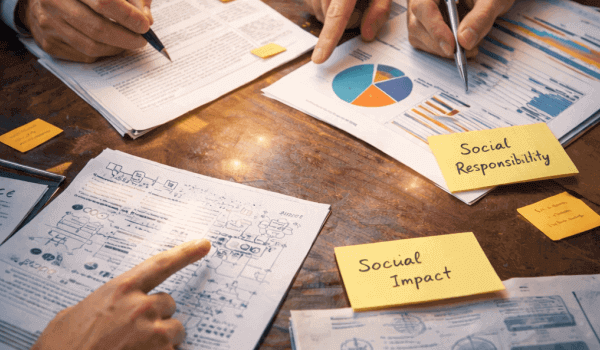
We bring together
actors from politics, public administration, business, education, and innovation who rarely sit at the same table.
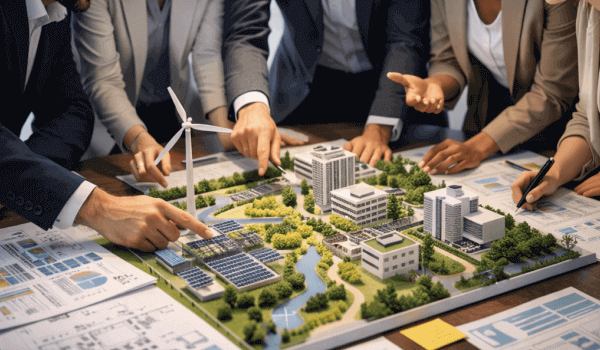
We translate
complex requirements between strategy, regulation, practice, and societal responsibility.
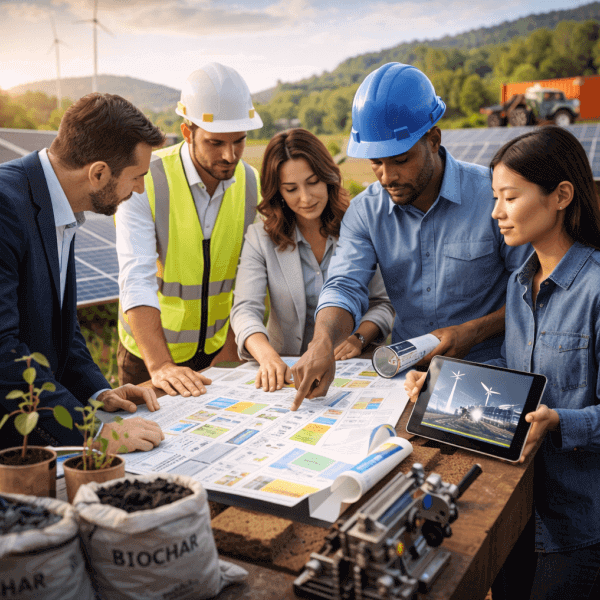
We shape
frameworks, collaborations, and demonstrators – not PowerPoint slides.
Impact emerges through experience and implementation
The German Federal Association for Sustainability has been working for many years at the interface of politics, business, education, and innovation. Our role as a strategic partner is not based on individual projects, but on continuous engagement with real transformation processes.
Our experience ranges from the development of qualification and orientation formats to international cooperation and the facilitation of complex systemic challenges across diverse regional and sectoral contexts.
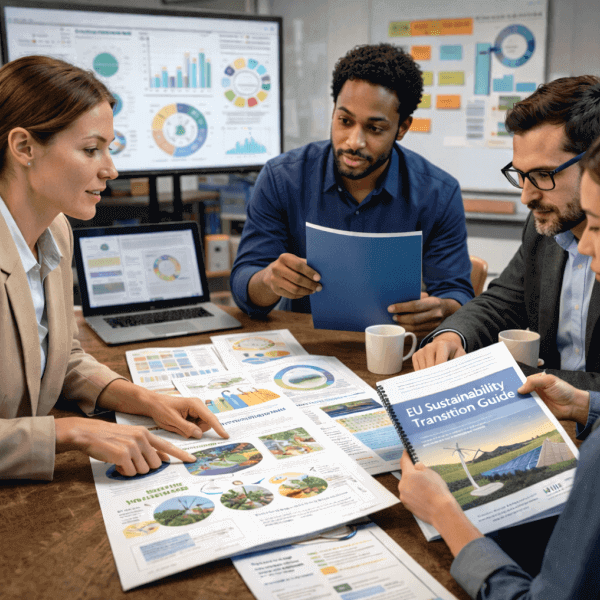
Field of Impact 1
Consulting & Implementation
We support (e.g. through consultancy) and develop pilot projects, demonstrators, and cooperation models that show how sustainable and resilient value creation can work in practice – within companies, regions, and international partnerships.
Field of Impact 2
Knowledge & Transfer
Our work results in studies, publications, guidelines, and educational formats that extend beyond individual projects and serve as frameworks for orientation for policymakers, public administration, and practitioners.
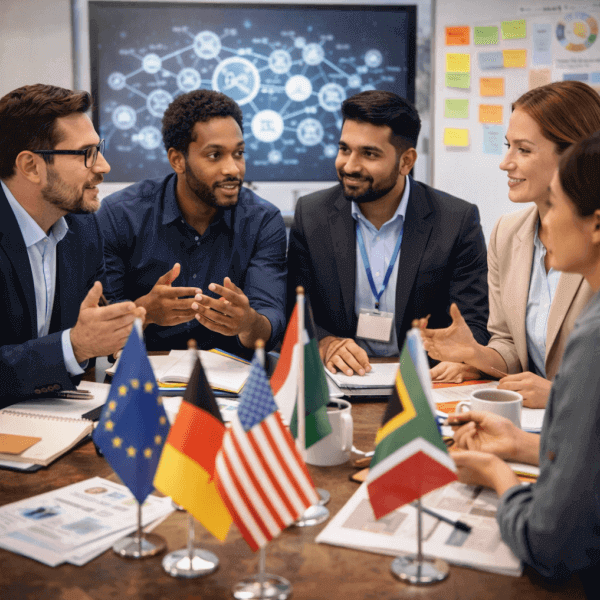
Field of Impact 3
Networks & Cooperation
We work within national and international networks alongside actors from public administration, business, education, and civil society. This networking forms the foundation for robust solutions beyond sectoral silos.
- Long-standing experience in sustainable development, vocational education and training, and transformation processes
- European and international cooperation, including in education, the bioeconomy, and nature-based value creation systems
- Recognition as a professional and dialogue partner for systemic sustainability and resilience issues
Impact emerges where long-term thinking, cooperation, and practical implementation come together.
Our strategic axes
The work of the German Federal Association for Sustainability is concentrated around a small number of clearly defined thematic fields. These strategic axes provide the framework within which we develop partnerships, support pilot projects, and build long-term structures.
They are deliberately designed to address ecological, economic, and societal challenges in an integrated way – rather than in isolation.
Axis 1
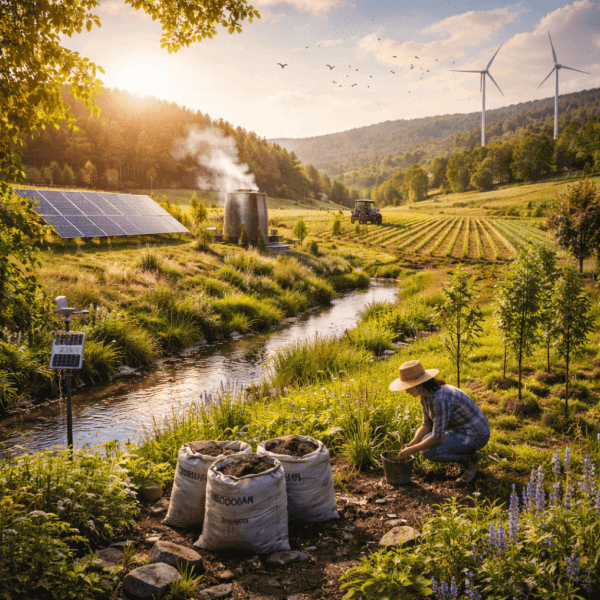
Nature-Based Resilience and Carbon Systems
Nature-based solutions are gaining increasing importance in the face of climate risks, resource scarcity, and geopolitical uncertainty. We do not view approaches such as plant-based carbon (biochar), regenerative agriculture, and sustainable land use as isolated measures, but as components of resilient value creation and climate systems.
We understand carbon removal not primarily as a technical issue, but as a question of governance, justice, and systems:
- How can climate action, regional value creation, and social stability be meaningfully connected?
- What role do nature-based approaches play compared to purely technical solutions?
- How can international perspectives – such as those from Africa – be integrated in a meaningful way?
Our focus lies on embedding these approaches within robust economic and political frameworks.
Axis 2
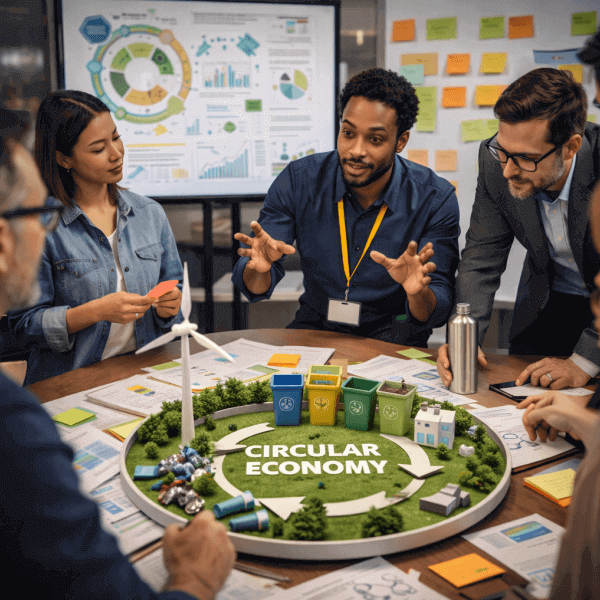
Future Skills and Education for Transformation
Transformation is not a purely technological process. It requires people, institutions, and organizations that are able to deal with uncertainty, take responsibility, and understand complex interdependencies.
We work on education and qualification approaches that:
- connect professional practice with sustainability and resilience challenges,
- provide orientation within transformation-related professions,
- strengthen not only knowledge, but also judgment and the capacity to act within a circular economy.
A particular focus lies on vocational education and training, the upskilling of professionals and leaders (see PIQUALI – Circular Skills Lab: Education for the Economy of Tomorrow), and the interfaces between education, business, and public administration.
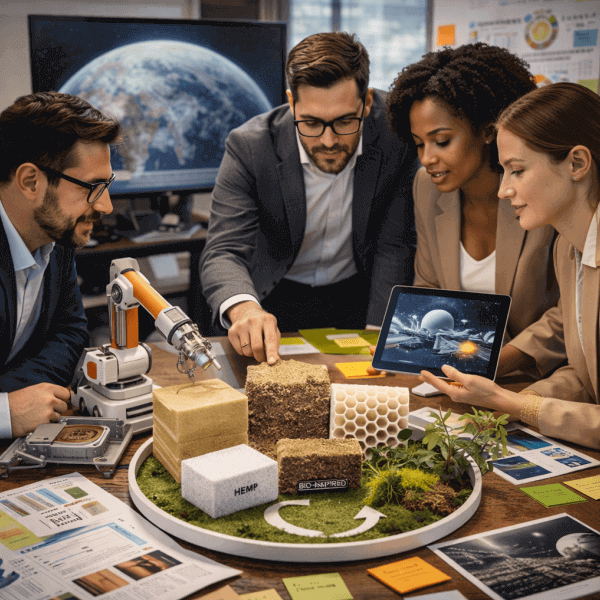
Axis 3
Material and System Innovation within Planetary Boundaries
Innovation is decisive for the future viability of economies and infrastructure. What matters, however, is how innovation emerges and the purpose it serves.
We work on:
- industrial applications of hemp and other bio-based materials,
- bio-inspired material and system approaches,
- the transfer of systems thinking from space technologies to terrestrial applications.
These perspectives help shape economic systems not only to be more efficient, but also more robust, resource-efficient, and adaptable. The focus lies on demonstrators, pilot applications, and systemic learning – not on short-term technology hypes.
What unites all three axes is the ambition to view systems as a whole. Ecological viability, economic performance, and societal stability are not treated as competing goals, but are considered together.
This gives rise to an approach that:
- realistically supports political objectives,
- takes economic practice seriously,
- and places long-term future viability at its core.
The future emerges where sustainability is expanded by resilience, orientation, and cooperation.
From these axes, concrete partnerships, projects, and references take shape.
Perspectives for Future Systems
Transformation is not only a technical or political task. It is also a matter of mindset, orientation, and dialogue. In podcasts, we discuss sustainable development, resilience, and future viability beyond buzzwords.
The conversations reveal how diverse perspectives come together – and why this is precisely the key to resilient systems.
The future emerges through dialogue – where different experiences come together.
Podcast
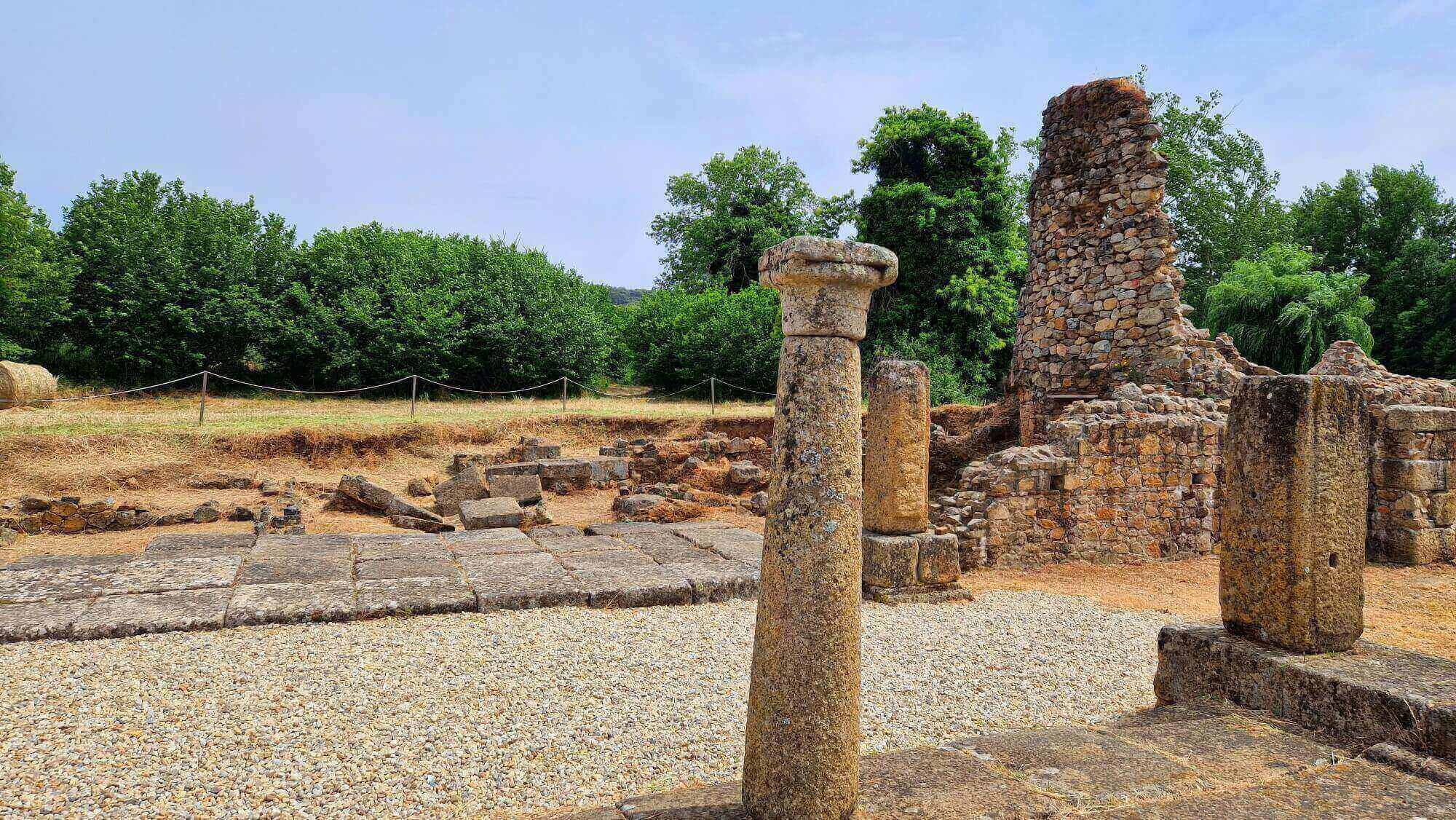
Circular Economy: Bridging Past and Future
Futurologist Michael Carl in conversation
with then Vice President Martin Wittau
and Archaeologist Dr. Joaquim Carvalho
Did you think that the circular economy was a modern invention? Think again! The Romans recycled glass, built more durably than we do today, and understood sustainability better than many corporations in the 21st century. Archaeology, history and the future come together at the Fundação Cidade de Ammaia archaeological site in Portugal. We talk about this as part of the Erasmus+ project PREP-CIRC – Preparing for Resilient VET Skills.
Podcast
Everyone can do Circular, except Economy
Futurologist Michael Carl in conversation
with then Vice President Martin Wittau
Nature can do the circular – and hardly anything else. Wherever we look: A supposed end is always the beginning of something new. Only we humans have been geared towards linear thinking, working and economic activity since the end of industrialisation at the latest. This is the source of prosperity and development in the first world, as well as the climate crisis and other phenomena.
Podcast
Shortage of skilled workers
Futurologist Michael Carl in conversation
with then Vice President Martin Wittau
If you really want to be a successful entrepreneur in the long term, you have to think and act sustainably. Success is a question of sustainable corporate policy. In this episode, Martin Wittau from the German Federal Association for Sustainability shows how a company that is consistently geared towards sustainability can also do better in the battle for skilled workers, young talents and labour.
Latest Posts
German Federal Association for Sustainability at Point Sud Workshop “Green and Digital Futures” in Kampala
Dr. Cosmas Lambini, Vice President of the German Federal Association for Sustainability, will represent the organisation at the international Point Sud Workshop “Green and Digital Futures: Rethinking the Twin Transition in Africa in an Era of Multiple Crises”, taking place from 18 to 22 May 2026...
Federal Association for Sustainability supports the Linnaeus Innovation Forum 2026
The German Federal Association for Sustainability supports the Linnaeus Innovation Forum 2026 (LIF2026) as a platform for exchange at the intersection of research, technology, business and sustainability. The forum brings together stakeholders from different sectors and creates space for...
Obituary: Rita Süssmuth – Integrity for Democracy and a Future-Ready Society
Rita Süssmuth has passed away. With her, Germany loses a public figure who never treated politics as a stage, but as a responsibility towards people, democratic institutions, and the reality of the world we live in. At a time when political communication is too often mistaken for strategic...
GFAS Vice President Dr. Cosmas Lambini Supports to Strengthen Social Sustainability in Sierra Leone’s Protected Areas
GFAS supports SAPA baseline assessment in Sierra Leone. As part of ongoing efforts to align biodiversity conservation with social sustainability and climate-resilient livelihoods, a Social Assessment of Protected Areas (SAPA) is currently being implemented across nine priority landscapes in Sierra...
New Partnership for Sustainability and Innovation
The German Federal Association for Sustainability (Bundesvereinigung Nachhaltigkeit e.V.) has today formed a consortium together with African Golden Food Ltd. (Ghana), Linnaeus Kompetenzzentrum Hanf gGmbH and Revita Hanfkontor GmbH. The aim is to develop innovative projects for food security, the...
New Executive Board of the German Federal Association for Sustainability elected
At the General Assembly of the Federal Association for Sustainability on 9 August 2025, the Executive Board was restructured. The previous Vice President, Martin Wittau, was elected President. The new Vice President is Dr. rer. nat. Cosmas Kombat Lambini, who previously served as Director of...
Record Funding Awarded for Erasmus+ VET Mobilities – Bundesvereinigung Nachhaltigkeit Receives Over EUR 2.16 Million
On May 8th, 2025, the 80th anniversary of the end of World War II in Europe, the German Federal Association for Sustainability received a remarkable recognition: A record grant of EUR 2,167,566.14 for Erasmus+ mobilities in VET was pledged to us by the National Agency at the BIBB as part of the...
GFAS President Tarik Mustafa appointed to the jury of the German Sustainability Award
We are delighted to announce that GFAS President Tarik Mustafa has been appointed to the jury of the German Sustainability Award. The prize is one of the most prestigious awards for sustainable business in Europe. Every year, companies that make a measurable contribution to transformation with...
GFAS cooperation with African Golden Food Ltd as part of the SEADE programme
Empowering Sustainable Growth in West Africa through AI and Industrial Hemp: GFAS joins the SEADE Programme As part of the EU-funded initiative SEADE – Strengthening Entrepreneurial Activities for a Digital Europe, the German Federal Association for Sustainability (BVNG) is proud to partner with...