

The End of Settlement
TEOS 2100 – A 2100 Foresight Report on Himalayan Water Collapse and the Rise of Post-Settlement Civilisation
What happens when permanent residence can no longer be taken for granted?
But what happens when the conditions supporting permanent residence become less reliable?
This question lies at the centre of The End of Settlement (TEOS 2100), an international foresight study published by the German Federal Association for Sustainability (BVNG).
The original idea for the thought experiment underlying TEOS 2100 dates back to 2017. It was conceived by Tarik Mustafa, former President of the German Federal Association for Sustainability (BVNG).
This initial concept provided the starting point for the interdisciplinary foresight study developed in 2026.
Combining scientific research with alternative future scenarios, the report explores how changing environmental conditions could affect human settlement, mobility and societal institutions over the long term.
The study begins with the transformation of water systems in the Hindu Kush Himalayan region. These mountain systems contribute to major Asian river basins and support livelihoods far beyond the highlands. Glacier retreat, changing precipitation patterns and increasing uncertainty about water availability may place pressure on agriculture, energy production, economic activity and existing settlements.
How societies respond to these developments remains an open question.
TEOS 2100 examines possible developments through the end of the twenty-first century. Its central concern extends beyond whether people will leave their homes. It explores how social institutions might change if people move more frequently, maintain their lives across several locations or increasingly organise economic and social relationships beyond established territorial boundaries.
From changing water systems to the future of institutions
Himalayan water systems support economic activities and communities across large parts of Asia. Changes in their seasonal reliability can affect food production, infrastructure and the ability of settlements to maintain essential services.
These consequences vary across river basins and communities. Glacier retreat does not necessarily produce a continuous decline in river discharge. Water insecurity does not automatically lead to migration.
Social consequences emerge through the interaction of environmental change with economic conditions, political decisions and people’s capacity to adapt.
TEOS 2100 brings these relationships together to examine a wider institutional question:
How can societies maintain rights, public services and political participation when permanent residence becomes less central to the organisation of people’s lives?
The report also considers people who cannot relocate or who choose to remain in their communities. The ability to stay is as relevant to human security as the freedom to move.
Four possible futures for 2100
TEOS 2100 develops four qualitative foresight scenarios. Each examines a different political and institutional response to environmental insecurity and changing patterns of mobility.
Fortress Earth
States respond to resource insecurity and environmental pressure through stronger border controls, territorial protection and restricted access to secure infrastructure. Opportunities for safety and economic participation become increasingly dependent on whether people live inside or outside protected areas.
The scenario examines the consequences of prioritising territorial security over broader cooperation.
Negotiated Mobility
Governments develop agreements concerning mobility, employment, public services and shared resources. Territorial sovereignty remains significant, but international and regional cooperation creates recognised pathways for movement and coordinates responsibilities across borders.
The effectiveness of these arrangements depends on political negotiation, financing and implementation.
Networked Nomads
Digital technologies and distributed infrastructure enable new forms of mobile living and employment. People can maintain economic and social relationships across locations without relying entirely on permanent residence.
At the same time, dependence on commercial platforms and privately controlled systems may create new forms of insecurity. Technological connectivity does not automatically guarantee social protection or political inclusion.
Planetary Transition
Societies develop more coordinated approaches to adaptation within ecological limits. Shared resource management, collective decision-making and cooperation play a greater role in economic and social organisation.
Yet conflicts over membership, political participation and resource allocation remain. Ecological coordination does not remove competing interests or the need for legitimate institutions.
These scenarios are not predictions. They explore contrasting possibilities and illustrate how political choices may influence the long-term consequences of environmental change.
Human experiences in the year 2100
he stories explore how different institutional arrangements might influence everyday life. Their characters encounter questions concerning employment, family relationships, access to water and healthcare, political membership and the ability to remain in places they consider home.
These narratives are not evidence of future events. They allow readers to examine possible institutional developments through individual experiences.
They also reveal why human mobility cannot be understood solely through transport, employment or access to infrastructure. Relationships, recognised rights and opportunities for participation remain central to people’s lives.
TEOS 2100 draws on published research concerning climate change, Himalayan water systems, migration, demography and governance.
The report distinguishes between observed developments, evidence-informed assumptions and constructed futures. Its methodological annex explains the analytical approach and the limitations of the scenarios.
The study does not calculate future migration flows or estimate the probability of a post-settlement civilisation. Nor does it suggest that cities, villages, territorial states or permanent homes will disappear.
Instead, it questions whether stable residence can remain the principal organising assumption of social institutions under all future conditions.
The report also considers the longer-term implications of human development within planetary boundaries, including the institutional requirements of possible activities beyond Earth. These questions extend its perspective without presenting space settlement as an alternative to addressing environmental problems on Earth.
An evidence-informed exploration of possible futures
The End of Settlement was published by the German Federal Association for Sustainability (BVNG) and developed by Martin Wittau together with an international student research team.
Authors: Martin Wittau, Ari Riak, Laina Redse, Madeleine Sleeper, Nicholas Levie, Ruby Putnam and Ximena Perez-Aragon.
Scientific review: Dr. Cosmas Kombat Lambini.
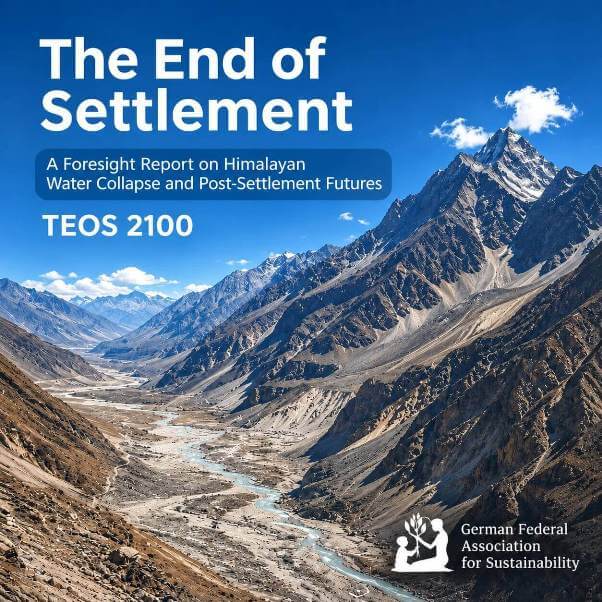
The English-language report was published on 14 November 2026 and is openly accessible through the Zenodo research repository.
Read and download the full report
https://doi.org/10.5281/zenodo.24222922
DOI: 10.5281/zenodo.24222922
Licence: Creative Commons Attribution-NonCommercial-NoDerivatives 4.0 International (CC BY-NC-ND 4.0), unless otherwise stated in the report.