

How might climate change, water insecurity and human mobility reshape the institutions that organise our societies? A new international foresight report published by the German Federal Association for Sustainability explores possible futures towards the end of the 21st century.
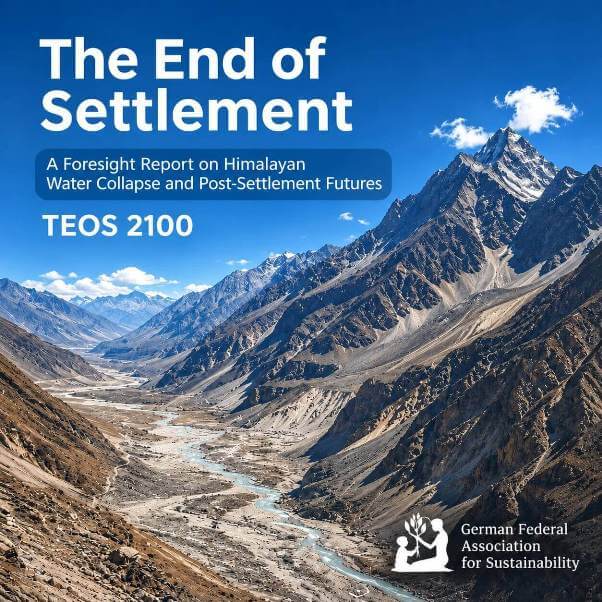 The German Federal Association for Sustainability has published The End of Settlement – A 2100 Foresight Report on Himalayan Water Collapse and the Rise of Post-Settlement Civilisation, an interdisciplinary study examining how environmental change could transform human settlement patterns and the institutions that govern social life.
The report addresses a fundamental question: What happens to societies built around permanent residence when the environmental conditions supporting that way of life become increasingly uncertain?
The Hindu Kush Himalaya as a Starting Point
The study focuses on the Hindu Kush Himalaya, a mountain region whose water systems influence the livelihoods of populations across large parts of Asia. Glacier retreat, changing precipitation patterns and growing uncertainty about water availability are already affecting the conditions under which communities organise their lives.
Yet environmental change does not automatically lead to migration. Whether people move, remain in place or develop new forms of living across multiple locations depends on economic opportunities, political decisions and the institutions available to support them.
TEOS 2100 examines these relationships and asks how established concepts of residence, citizenship, public services and political participation might evolve under changing environmental conditions.
Four Possible Futures towards 2100
The report develops four qualitative scenarios representing different societal responses to environmental uncertainty.
- “Fortress Earth” explores a world of increasing territorial protection and exclusion.
- “Negotiated Mobility” examines international agreements governing movement and shared responsibilities.
- “Networked Nomads” considers the possibilities and dependencies of digitally connected, geographically distributed societies.
- “Planetary Transition” explores more coordinated forms of societal adaptation within ecological limits.
These scenarios are not predictions. They provide alternative perspectives on how political choices and institutional developments could shape the future.
The scientific analysis is accompanied by eight fictional narratives set in 2100. Through individual experiences, these stories explore how different institutional arrangements might affect everyday life, access to essential services and opportunities for participation.
Rethinking Sustainability and Societal Resilience
With TEOS 2100, the German Federal Association for Sustainability extends its work on long-term societal development and resilience.
The report connects findings from climate and water research with questions of migration, governance and social protection. It examines whether institutions originally designed for predominantly settled populations can continue to provide rights, services and political representation under changing patterns of mobility.
“The End of Settlement” does not suggest that cities, villages or permanent homes will disappear. Instead, it questions the assumption that permanent settlement will necessarily remain the central organising principle of societies under all future conditions.
The report was developed by Martin Wittau together with an international student research team and scientifically reviewed by Dr Cosmas Kombat Lambini.
The English-language report was published on 14 November 2026 and is available here