

Dr Cosmas Kombat Lambini, Vice President of the German Federal Association for Sustainability (BVNG), is supporting the introduction of a methodology for assessing governance and social equity in protected areas across five Central Asian countries in his capacity as a research consultant for the International Institute for Environment and Development (IIED).
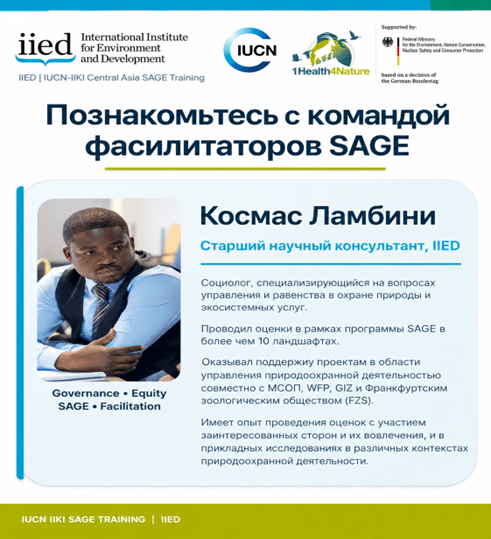 On 12 and 14 October 2026, he co-delivered two training modules with regional project partners. The modules covered the methodological foundations, the analysis of relevant stakeholder groups, and the practical implementation and evaluation of SAGE assessments. The training prepared national and local project teams to conduct assessments independently while ensuring the participation of different stakeholder groups. Russian-language materials facilitated cooperation across the participating countries.
Lambini brings experience from SAGE processes in more than ten landscapes, as well as from international projects involving IUCN, WFP, GIZ and the Frankfurt Zoological Society. He will continue to provide methodological guidance to the project teams during subsequent assessments, quality assurance processes and the development of practical improvement measures.
SAGE: Good Governance and Equitable Participation
An important component of the project is the introduction of the *Site-level Assessment of Governance and Equity* (SAGE) methodology, developed by the International Institute for Environment and Development (IIED) and its partners. SAGE examines how decisions concerning protected areas are made, which stakeholders are involved, and to what extent rights, interests and local knowledge are taken into account. The methodology enables authorities, conservation organisations and local communities to jointly assess existing governance structures and develop measures for improvement. In this way, SAGE complements the ecological and health-related activities of the One Health project by adding a social and institutional perspective.
How can nature conservation, public health and the participation of local communities be better integrated? This question is at the heart of the international project “Enhancing landscape resilience to zoonotic disease emergence by consolidating nature conservation systems in Central Asia”, funded through the International Climate Initiative (IKI) and implemented by the International Union for Conservation of Nature (IUCN). The project covers Kazakhstan, Kyrgyzstan, Tajikistan, Turkmenistan and Uzbekistan. It follows the One Health approach, which recognises the interconnectedness of human, animal and ecosystem health.
The project demonstrates that effective conservation and public health measures depend on well-functioning institutional cooperation and meaningful public participation. For the German Federal Association for Sustainability, this approach is also relevant beyond nature conservation: sustainable development requires ecological objectives, social equity and institutional capacity for action to be considered together.
– Internationale Klimaschutzinitiative (IKI)
– International Union for Conservation of Nature (IUCN)
– IIED: Site-level Assessment of Governance and Equity